
Donation tax credits - Proposed changes

July 1, 2026


Budget 2026 included a number of proposed changes to donation tax credits, which may affect both donors and charities from 1 April 2027. As with many Budget announcements, these changes are not yet finalised, so it’s a case of staying informed for now rather than making any immediate changes.


At a high level, the Government is looking to tighten the rules for larger donations, while also making it easier for donors to access and use their credits.


One of the most talked-about changes is the introduction of a maximum entitlement. Currently, individuals can claim a donation tax credit of 33⅓% of their donations, up to the level of their taxable income. The proposal introduces a cap so that donations eligible for the credit are limited to the lower of $100,000 or the donor’s taxable income. This effectively limits the maximum annual refund to $33,333.33.


For most people, this won’t make much difference. However, it will impact individuals making large one-off or high-value donations, as any amount above the cap will no longer generate a tax credit.


Alongside the cap, there are also proposals aimed at improving how and when donation tax credits are received.

One of these is the ability to receive in-year refunds. At the moment, most donation tax credits are claimed after the end of the tax year. The proposed change would allow credits to be refunded during the year the donation is made, improving cashflow for donors.  


Another proposal is to allow donors to transfer their tax credit directly to the charity. In practice, this would mean the benefit of the tax credit could go straight to the organisation, rather than being refunded to the individual first. This is intended to simplify the process and could also help charities receive funding sooner.


Taken together, these changes reflect a shift in how the Government is approaching charitable giving. There’s a clear focus on limiting the fiscal cost of large claims, while also making the system more flexible and accessible for everyday donations.


At this stage, the key takeaway is that these changes are still proposed and subject to change. If they go ahead, the impact will likely be limited for most donors, but those making larger donations, or charities relying on them, may need to rethink their approach.



July 1, 2026
Cash flow is often the difference between a business that thrives and one that struggles. Many profitable businesses experience financial pressure simply because cash is not arriving when it is needed. The good news is that cash flow problems are often preventable. By monitoring a few key areas and acting early, business owners can significantly improve their financial position and reduce stress. 1. Strengthen Your Debtor Management One of the most common causes of cash flow pressure is slow-paying customers. Many business owners are reluctant to follow up overdue accounts, but every dollar sitting in debtors is money unavailable to pay wages, suppliers, tax obligations, or invest back into the business. Consider the following: Invoice promptly after work is completed. Clearly state payment terms on invoices. Send automated reminders before invoices become overdue. Follow up overdue accounts with a phone call rather than relying solely on email. Require deposits for larger projects. Review customer credit limits regularly. Even reducing your average collection period by a few days can have a significant impact on available cash. 2. Set Aside Money for Tax Before It Is Due Many businesses find themselves under pressure when GST, PAYE, or provisional tax falls due because the funds have already been spent. A simple but effective strategy is to maintain a separate tax savings account and transfer money into it regularly. For example: GST registered businesses can transfer the GST component of sales into a separate account. Employers can set aside PAYE and KiwiSaver deductions immediately after each payroll. Businesses can estimate their income tax liability throughout the year and save towards it monthly. Treating tax as money that belongs to Inland Revenue rather than part of working capital can prevent unpleasant surprises and reduce the need for payment arrangements later. 3. Manage Working Capital Carefully Working capital is the cash tied up in debtors, stock, and short-term business operations. Business owners often focus heavily on sales growth without considering the impact on cash flow. Key areas to monitor include: Stock Levels Excess stock ties up cash and may become obsolete. Review inventory regularly and identify slow-moving items. Creditor Terms Take advantage of supplier payment terms where appropriate, but maintain good relationships with key suppliers. Project Management For service businesses, ensure work is billed as it progresses rather than waiting until completion. Regular Cash Flow Forecasting A simple 13-week cash flow forecast can identify future shortfalls before they become critical. Businesses that forecast cash flow are generally able to make better decisions regarding staffing, purchasing, and investment. 4. Recognise the Early Warning Signs Cash flow problems rarely appear overnight. Common warning signs include: Constantly using overdraft facilities. Struggling to pay suppliers on time. Increasing use of credit cards to fund operations. Delaying GST or PAYE payments. Owner drawings continuing despite declining profitability. A growing debtor balance. Regular requests from creditors for payment. The earlier these issues are identified, the more options are available to address them. Many business failures occur not because the business is unprofitable, but because warning signs were ignored for too long. 5. Set Up Inland Revenue Arrangements Early If a business is unable to pay tax on time, it is generally better to contact Inland Revenue early rather than wait for debt collection action. Inland Revenue will often consider instalment arrangements where a business is experiencing temporary cash flow difficulties. Benefits of acting early include: Greater flexibility in repayment options. Reduced risk of enforcement action. Better management of cash flow. Improved ability to meet future tax obligations. However, payment arrangements should be viewed as a temporary solution rather than an ongoing funding source for the business. If tax debt is becoming a recurring issue, it is important to understand the underlying cause and implement long-term improvements to cash flow management. Final Thoughts Strong cash flow management is not about complicated financial strategies. It is about maintaining good business disciplines: Collect debtors promptly. Save for tax obligations. Monitor working capital. Watch for warning signs. Address problems early. Regular management reporting and cash flow forecasting can provide valuable insights and help business owners make informed decisions before issues become serious. If you would like assistance reviewing your business cash flow, forecasting future cash requirements, or managing tax obligations, the team at McIsaacs would be happy to help.
July 1, 2026
One of the biggest differences we see between businesses that thrive and those that struggle is visibility. Put simply—if you don’t have up-to-date financial information and a clear plan, it’s very difficult to make confident decisions. Regular reporting and budgeting aren’t just compliance exercises. They’re tools that help you actually run your business. Good reporting gives you a clear picture of where things stand right now. Are you profitable? Is cash flow tight? Are costs creeping up? Without regular reporting, these issues often go unnoticed until they become a problem. Budgeting, on the other hand, is about looking forward. It helps you set targets, plan for growth, and understand what needs to happen financially to achieve your goals. A well-prepared budget becomes a benchmark—you can track how you’re performing and make adjustments early, rather than reacting after the fact. When reporting and budgeting work together, you move from being reactive to proactive. This is where a Virtual CFO can add real value. A Virtual CFO goes beyond traditional compliance and annual accounts. The focus is on helping you understand your numbers, plan ahead, and make informed decisions throughout the year—not just at balance date. In practical terms, a Virtual CFO can help with: Regular management reporting (monthly or quarterly) so you know exactly how your business is performing Developing and maintaining budgets and forecasts Cash flow planning to avoid surprises Identifying trends, risks, and opportunities early Providing strategic input around growth, pricing, and costs Acting as a sounding board for business decisions For many businesses, having a full-time CFO isn’t realistic. A Virtual CFO gives you access to that level of insight and support in a flexible and cost-effective way. We often find that once clients start receiving regular reports and working with a budget, their confidence improves significantly. They feel more in control, are able to make decisions faster, and can see issues coming before they become serious problems. As accountants, our role isn’t just to prepare accounts after the fact—it’s to help you understand what the numbers mean and how to use them to move your business forward. Our Directors and Associate Directors are available to assist clients with management reporting, budgeting, and Virtual CFO services. If you’d like to get better visibility over your business and plan ahead with confidence, feel free to get in touch.
July 1, 2026
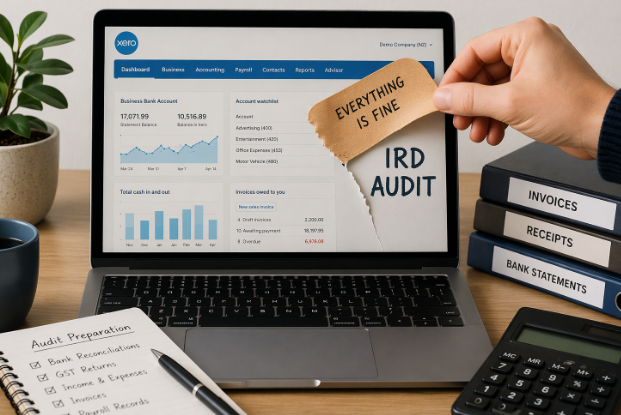
Inland Revenue has made it clear that compliance activity is increasing. With additional funding, enhanced data-matching capabilities, and access to more information than ever before, IRD is identifying discrepancies and compliance issues much faster than in previous years. While most business owners aim to meet their obligations correctly, even minor errors can result in interest, penalties, reviews, or audits. Many reviews begin because something reported in a tax return simply doesn't look right when compared with previous years, industry benchmarks, or information received from other sources. Significant GST refunds, repeated business losses, inconsistent reporting patterns, and a history of late filing or payment can all attract additional attention. A review does not necessarily mean that a business has done something wrong, but it does mean that IRD may ask questions and expect supporting documentation. Some of the most common issues arise in the areas of GST and payroll. Businesses can inadvertently claim GST on expenses that do not qualify, fail to account for private use adjustments, incorrectly treat certain transactions or Fringe Benefit Tax obligations are not correctly calculated. Small errors repeated over time can become significant amounts, making regular reviews of accounting and payroll systems an important part of managing risk. Underlying all of these areas is the importance of good record-keeping. Accurate records remain one of the best protections against compliance problems. Businesses should ensure they retain invoices, receipts, bank statements, payroll records, loan documentation, and evidence supporting deductions claimed in their tax returns. Well-maintained records not only make compliance easier but also allow questions from Inland Revenue to be answered quickly and confidently. The reality is that Inland Revenue's increased compliance activity is unlikely to slow down. The businesses that experience the fewest problems are generally those that maintain accurate records, review their systems regularly, seek advice when needed, and address issues before they become significant. It may be a good time to consider Audit Shield Insurance which we offer to our clients. It covers the professional fees incurred as a result of an IRD review or audit activity of any tax type. It also covers previously lodged returns. Please contact us if you would like a quote for Audit Shield Insurance. 
July 1, 2026
Succession planning often sits in the “too hard” basket. If it has crossed your mind, it’s likely crossed your family’s mind too—but no one wants to be the first to raise it. We see this all the time. There’s an “elephant in the room” dynamic, driven by a few common barriers: Children don’t want to appear focused on money or raise their parents’ mortality Parents don’t want to talk about their own mortality Concerns about fairness between family members Fear of creating conflict Feeling overwhelmed or not ready to step back What’s interesting is that none of these challenges are financial or legal—they’re emotional. That’s why the most successful succession plans start with the people side. Before jumping into structures and tax outcomes, families need open, guided conversations to work through expectations, concerns, and assumptions (many of which turn out to be incorrect). This is where an experienced accountant who is a family business specialist can add real value. They help facilitate discussions, keep things moving, and translate advice between your lawyer, and other advisors. Once there’s alignment, your professional team can step in with the right technical structure and implementation. A good succession process needs to strike a balance between confidentiality and transparency, which requires trust and careful handling. If the emotional side isn’t addressed properly, even the best technical plan can fail—leading to tension, breakdowns in relationships, and risk to the business itself. The key takeaway? Start the conversation early. With the right support, succession planning doesn’t have to be overwhelming—and getting it right protects both your family and your business for the future. 
July 1, 2026
If you’ve ever dealt with Fringe Benefit Tax (FBT), you’ll know it can be one of the more frustrating parts of running a business. Between tracking vehicle use and keeping logbooks, it’s not exactly straightforward. The Government is looking to change that, with proposed changes expected to apply from 1 April 2027. At this stage though, it’s important to stress that these are still proposals only. The legislation hasn’t been finalised, and the details could change before anything becomes law. So for now, there’s nothing you need to do differently — but it’s worth understanding what’s being considered. The main focus of the proposed changes is how FBT applies to company vehicles. Under the current rules, you need to determine whether a vehicle is available for private use, which often means keeping detailed records, tracking days, and in many cases maintaining logbooks. It can be time-consuming and tedious. The proposal is to introduce a simpler, category-based system. Rather than tracking actual usage, vehicles would be grouped based on how they are generally used, and a set percentage would be applied. The proposals are: Category Type of Use Indicative FBT Treatment Full private use Vehicle is essentially provided as a perk 100% taxable Partial private use Mainly business use, but some personal use allowed ~35% taxable Minor private use Limited to commuting or very minor personal use Reduced rate (around 20%) No private use Pool vehicles or strictly business use only 0% taxable The idea is that instead of tracking usage throughout the year, you would assign a category when the vehicle is provided and only revisit it if the use changes. From a compliance point of view, this would remove the need for logbooks and day-by-day tracking, which will be appealing for many businesses. That said, while the rules may become simpler, they won’t necessarily produce a better tax outcome for everyone. Standardised percentages mean some businesses could end up paying more FBT than they do under the current approach, particularly where private use is low and well documented. There’s also a bit more judgement involved upfront in deciding which category a vehicle falls into. It’s also worth highlighting these proposed changes don’t affect all businesses in the same way. For close companies with shareholder-employees, the existing option of using a logbook and apportioning vehicle costs between business and private use is still available. This approach can allow you to avoid FBT entirely and instead claim deductions based on actual usage, which for some remains a more practical and tax-efficient method where private use is minimal. You might find it useful to start thinking about how your vehicles are currently used and where they might sit under the new categories, but there’s no need to make any changes until the rules are finalised. Overall, these proposals are part of a broader push to simplify FBT, which is something most businesses will welcome. Whether it results in a better outcome will depend on your specific situation, so it will be worth reviewing things carefully once we have confirmed legislation. We’ll continue to share updates as more detail becomes available.
March 26, 2026
As we enter the 2026–27 financial year, a number of confirmed tax and compliance changes are set to impact individuals, employers, and businesses across New Zealand. While 2026 is not a year of sweeping tax reform, several important adjustments will influence payroll costs, cash‑flow planning, and personal finances. Here’s a clear breakdown of what clients should be aware of. ACC Earners’ Levy Increasing From 1 April 2026 , the ACC earners’ levy will rise to 1.75% , up from the current 1.67%. This affects all employees and self‑employed earners. Employers should budget for slight increases in payroll costs, while employees will notice slightly higher deductions from their earnings. Minimum Wage Uplift The adult minimum wage will increase to $23.95 per hour from 1 April 2026. This change has flow‑on effects: raising holiday pay, ACC, and KiwiSaver contributions, and often triggering wider wage adjustments to maintain internal pay relativity. KiwiSaver Default Contribution Rates Increasing From 1 April 2026 , both employee and employer default KiwiSaver contribution rates will increase from 3% to 3.5% , with a further step‑up to 4% in 2028 . Businesses should prepare now by adjusting payroll systems and forecasting the increased employer contribution cost. Income Tax Brackets Staying the Same Despite speculation, no new income tax bracket changes have been announced for 2026. Personal tax rates, the company tax rate (28%), and GST (15%) remain unchanged for the 2026 year. What This Means for You While these changes are mostly incremental, they still impact payroll, wages, and personal budgeting. Reviewing cash‑flow and payroll processes early will help prevent compliance issues or unexpected cost overruns. If you’re unsure how these updates affect your situation, our team is here to help you plan ahead.
March 26, 2026
As we draw close to the end of another financial year, to assist you with your end of year close off we have provided a list of things to do before 31 March , on 31 March , and soon after 31 March . Before 31 March 2026 Bad Debts Please review your Debtors Ledger for any bad debts. To claim a deduction for bad debts, the defaulting accounts MUST be written off your Debtors Ledger prior to the 31st of March 2026. It is not enough to actually reduce the amount of the debtors after balance date by the amount of estimated bad debts or unrecoverable amounts owing. In most accounting systems this means creating a credit note to the defaulting debtors account and coding it to the account code Bad Debts. If the original invoice included GST, then you can claim GST on the credit note. Fixed Assets Review the fixed asset register for items that have either been sold or scrapped during the year. The Fixed Asset schedule can be found in your previous years Financial Statements. If you need another copy, contact our office for a copy. Please ensure you have narrated the entries coded to fixed assets with enough information for us to determine what has been purchased and have copies of invoices and any related financing readily available for us. Repairs & Maintenance It's a good time to review what you have coded to fixed assets and repairs and maintenance. All assets costing less than $1,000 (excl GST) may be claimed as an expense in the year of purchase, amounts greater than $1,000 (excl GST) could potentially be fixed assets. Please ensure you narrate these well in your accounting system for us to reduce queries on the job. Structures & Financing It may be time to consider an alternative structure or financing method for your business. Now is the time to consider Companies, LTC's and Trusts. If you are interested please contact us. Dividends It may be appropriate to declare a dividend on or before 31 March. This may require top up income tax to be paid by 31 March 20266 On 31 March 2026 Trading Stock Your stock (including work in progress) must be counted, recorded and valued at 31 March 2026. The trading stock rules require that you value at the lower of cost, net realisable value or market selling value. Remember to exclude GST from your calculations and prepare a written record of your stocktake. Stock value less than $10,000 - if your total gross income for the year is $1.3 million or less; and - you can reasonably estimate your stock on hand at 31 March 2026 to be less than $10,000 (excl GST), you can choose not to value your closing stock or to include any change in value. Holiday Pay & Wage Reports Some payroll software systems do not allow for printing reports subsequent to 31st March, so ensure you have the reports printed as close to the end of the month as practical. This is particularly important for clients who accrue holiday pay outstanding at balance date. Shortly after 31 March 2026 Year End Bank Reconciliations If you have a computerised cashbook (Xero, MYOB etc.) , when you receive your bank statement for 31 March 2026, ensure all transactions are entered for the year, perform a bank reconciliation to this date being 31 March 2026 and print a hard copy for your records. PAYE Payments Due 5 th /20 th April 2026 If you intend to pay out Directors Fees or additional bonus / top up salaries to either your employees or shareholder employees, you will need to pay to the IRD the PAYE content of the payments by the 5 th or 20 th of April 2026. Dividend RWT Payments Due 20th April 2026 If you intend to declare dividends on 31 March 2026 you will need to pay relative RWT content by 20 April 2026. Interest RWT Payments Due 20th April 2026 If you intend to pay interest on loan accounts at 31 March 2026 you will need to pay to the IRD the RWT content of the interest by 20 April 2026. 3rd Provisional Tax Instalment Due 7th May 2026 (for 31 March balance dates) The final instalment of 2026 Provisional tax is not due till after the end of the year. While this may be good for cash-flow, it could have negative implications if you want to pay a dividend this year. If you think this affects you, and you would like us to review your imputation credit account or have any concerns, please contact us. PREPARATION OF YOUR 2026 ANNUAL FINANCIAL STATEMENTS & INCOME TAX RETURNS Our Client Annual Checklists are available on our website at www.mcisaacs.co.nz under the "Financial Resources" tab, "Client Annual Checklists". To simplify these checklists we have separated them out into the type of entity and provided specific ones if you have a rental property or mixed use assets. 2026 Business Checklist 2026 Personal Checklist 2026 Rental Checklist 2026 Mixed Use Holiday Home, Boat and Plane Checklist These need to be completed and signed before we process your 2026 information. The accuracy and completeness of this information you provide has a direct influence on the time required to perform your assignment. When you have compiled your financial records for us please remember to include the completed and signed Checklist(s). If you do not have access to our website and require a copy of the Checklists, please give us a call and we can email a pdf of them to you or we will post them to you, whichever you prefer.
March 26, 2026
Our Client Annual Checklists are available on our website at www.mcisaacs.co.nz under the "Financial Resources" tab, "Client Annual Checklists". To simplify these checklists we have separated them out into the type of entity and provided specific ones if you have a rental property or mixed use assets. 2026 Business Checklist 2026 Personal Checklist 2026 Rental Checklist 2026 Mixed Use Holiday Home, Boat and Plane Checklist 2026 Livestock Checklist These need to be completed and signed before we process your 2026 information. The accuracy and completeness of this information you provide has a direct influence on the time required to perform your assignment. When you have compiled your financial records for us please remember to include the completed and signed Checklist(s). If you do not have access to our website and require a copy of the Checklists, please give us a call and we can email a pdf of them to you or we will post them to you, whichever you prefer.
December 19, 2025
Over the last six to twelve months Inland Revenue (IRD) has been taking a firmer stance when it comes to collecting overdue tax. This is in the form of increased liquidation action and enforced withdrawals directly from a taxpayer’s bank account. Given the potential for IRD to take action it is more important than ever to engage with IRD, rather than put your head in the sand. Ideally, you can negotiate and enter into an instalment arrangement with IRD to clear the debt. The benefit of doing so is that IRD will hold off from taking action while the terms of an instalment arrangement are being met, and there is the potential for penalties to be remitted once the debt is cleared. However, entering into an instalment arrangement can be easier said than done. Understandably, IRD takes the view that it should not be used as a bank to support a business that is unable to meet its obligations. This would provide an unfair advantage over competitors and would be unfair to those who do comply. Hence, IRD now expects businesses seeking instalment arrangements to demonstrate both their ability to meet proposed repayments and to stay current with ongoing tax obligations. It is therefore not necessarily a question of whether the business has ‘any’ free cashflow to pay its tax, but whether it has sufficient cashflow to meet its future obligations, plus amounts that are already owed. If a business can enter into an arrangement to pay ‘something’ but will continue to fall further behind, IRD will likely decline the request and the business should therefore ‘fail’ rather than continue to trade without being able to meet its obligations. A hard line will also be taken on PAYE and GST as these are regarded as Crown funds held in trust by the business until they are paid to IRD. Non-payment of employer deductions is a criminal offence. Penalties can include fines, imprisonment, and shortfall penalties of up to 150 percent. Company directors and officers may also be held personally liable if they are aware of ongoing non-payment. A proposal to enter into an instalment arrangement will likely require the following information to be submitted: how much can be paid weekly, fortnightly or monthly, a statement of assets and liabilities, forward looking budgets, and cashflow forecast. If specific transactions are anticipated that are relevant, such as equity from a new investor, IRD could ask for details of that transaction, such as Term Sheets, Sale and Purchase Agreement and details of the investor. Their purpose being to assess whether the transaction has a real prospect of occurring or not. The IRD’s tougher stance highlights the growing importance of compliance and proactive engagement. Businesses should act early to manage their tax obligations, seek professional advice when needed and avoid using tax funds as working capital.
December 19, 2025
As of 1 July 2025, the Depositor Compensation Scheme (DCS) has come into effect to protect the savings of individuals and businesses if a bank or other "deposit-taker" fails. Managed by the Reserve Bank of New Zealand, the scheme is designed to strengthen public confidence in the country's financial system and promote stability during times of economic stress. Under the scheme, eligible deposits held with licensed banks, credit unions, and building societies are protected up to a limit of NZD 100,000 per depositor, per institution. This means that if a participating institution is unable to meet its obligations, depositors will be repaid up to the coverage limit. The DCS covers common deposit products such as savings accounts, transaction accounts, and term deposits. However, it does not extend to investments such as shares, bonds, or managed funds (KiwiSaver and other superannuation schemes), nor does it cover deposits held with unlicensed or overseas institutions. The scheme will be funded by levies on participating financial institutions rather than taxpayers. This ensures that the cost of protection is borne by the industry itself. By introducing the DCS, New Zealand joins many other developed countries that already have similar safeguards in place, giving people added confidence that their money is secure even in the event of a bank failure.